
25 Mar 2026
Seafish hosts UK seafood stakeholders at world-leading Danish flume tank
Visit advances understanding of fishing gear and sustainability
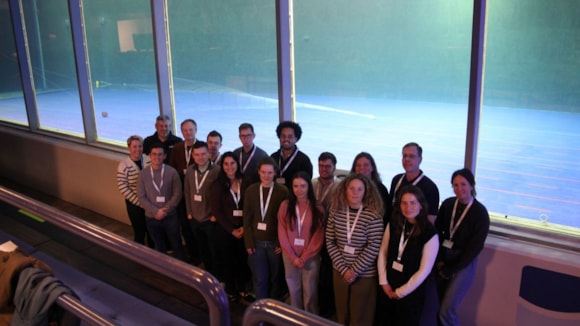
Seafish has hosted a visit by UK seafood stakeholders to the flume tank facility in Hirtshals, Denmark, offering greater insight into fishing gear innovation, performance and sustainability.
The trip brought together 14 representatives from the UK seafood supply chain, government and environmental organisations. The aim was to build a shared understanding of how fishing gear design and operation influence catch efficiency, environmental impact and the ability to supply different species to meet market demand.
Seafish’s Fishing Gear Innovation Manager, David Warwick, organised the visit as part of Seafish’s ongoing work to support a more informed, connected and future-ready seafood industry.
David said: “Growing consumer demand for responsibly sourced seafood is driving the need for more sustainable wild-capture fishing. Innovative fishing gear plays a critical role by improving selectivity of target species, protecting seabed habitats and improving energy efficiency.
“Bringing together stakeholders from across the UK seafood sector to see fishing gear in action helps build a shared understanding of how the industry operates in practice. The flume tank provides a unique environment where you can clearly see how small changes in design or rigging affect performance, selectivity and environmental impact. That insight is invaluable for informing decision-making across policy, supply chains and sustainability initiatives.”
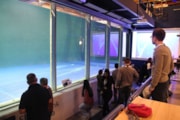
The flume tank is an internationally recognised centre for testing and training in trawl gear technology. It provides a controlled environment where model fishing gear, including trawl nets and doors, can be assessed under simulated conditions, enabling detailed insight into how gear behaves in the water.
During the visit, participants explored practical approaches to improving gear performance and sustainability. This included examining selective devices that support the release of juvenile fish and reduce unwanted bycatch, as well as how adjustments to the rigging of nets and trawl doors can lessen seabed impact and improve vessel energy efficiency.
Through demonstrations and discussion, the group developed a clearer understanding of how gear components work together, how gear design influences the species caught, and why fishers select particular configurations to meet market demand. The programme also highlighted how innovation in gear design can support both environmental outcomes and operational efficiency, including improving selectivity and reducing fuel use.
While the flume tank is particularly suited to analysing mobile gear such as trawls, the programme also included discussion of other fishing methods to provide broader context.
Dr Rufus Danby, Fisheries Policy Officer at SWFPA, who took part, said:
“The visit was a unique opportunity to see firsthand how the gear behaves and operates in the water, which is something that can’t be fully appreciated from looking at a picture or diagram. It was very beneficial in further developing my understanding of how the industry operates, and it generated a lot of valuable discussion within the group, particularly given the mix of roles across policy and the supply chain.”
Emily Theobald, CFPO Science and Policy Lead, said: “This was a fantastic opportunity to see fishing gear in action that I would not get elsewhere. I was particularly interested in trawl doors and different set-ups, as I am working with fishermen who are eager to trial configurations that reduce bycatch, lower fuel use and improve overall effectiveness. It was really valuable and has given me ideas I can implement in my role.”
ENDS
For further information, please contact Jane Smernicki, Seafish Head of Communications: jane.smernicki@seafish.co.uk
NOTES TO EDITORS
Participants the visit included representatives from DAERA, DEFRA, CEFAS, Co-op, Morrisons, Tesco, Joseph Robertson, Thistle Seafoods, the Cornish Fish Producers’ Organisation (CFPO), the Scottish White Fish Producers Association (SWFPA), WWF, The Crown Estate, Northumberland IFCA and the Marine Stewardship Council (MSC).
About Seafish
Seafish is here to give the UK seafood sector the support it needs to thrive.
We’re a non-departmental public body (NDPB) set up by the Fisheries Act 1981. Our sponsors are the Department for Environment, Food and Rural Affairs (Defra) and the Scottish, Welsh and Northern Irish devolved administrations.
Using our unique, non-competitive position, we work in partnership with businesses, Government and organisations to overcome challenges and seize opportunities.
Funded by a levy on the first sale of seafood in the UK, our work makes a huge difference. It keeps fishermen safe, supports sustainable sourcing, helps businesses work efficiently, and boosts the nation’s health. We tackle everything from research to campaigns, insights to training – whatever we can do to give our industry the support it needs.
Visit our website www.seafish.org or follow us on Twitter, LinkedIn and YouTube.
Contact Information
Jane Smernicki
jane.smernicki@seafish.co.uk

Powered by Onclusive PR Manager © 2026